
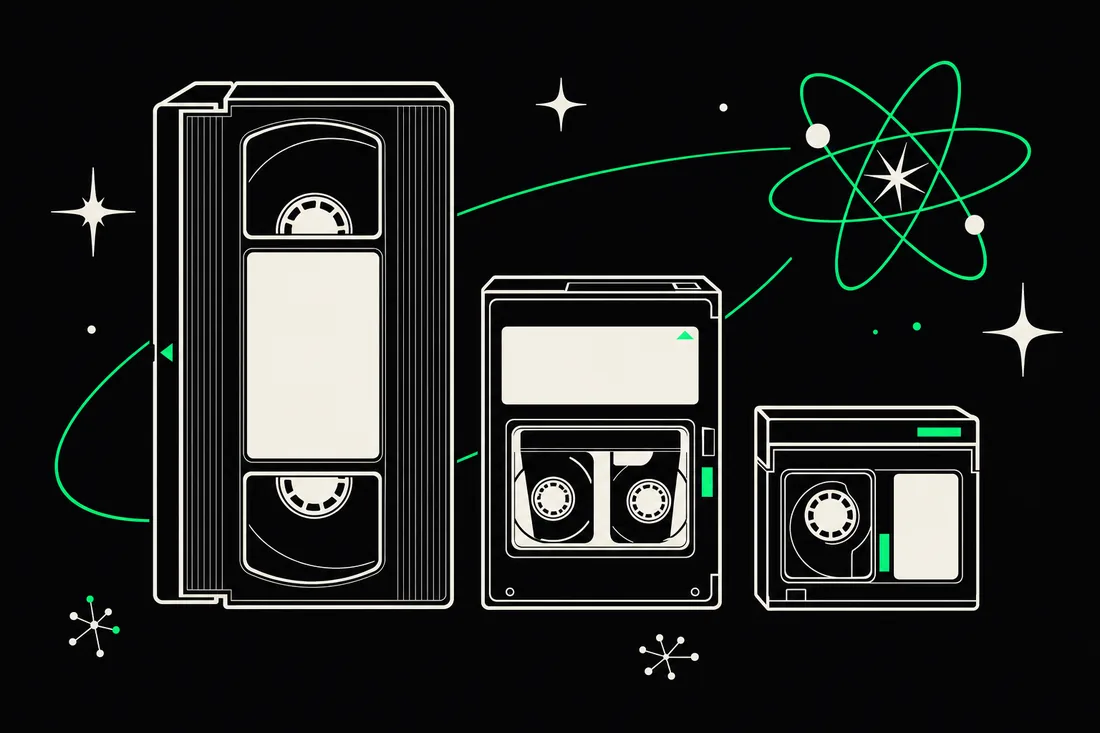
Open a box of old home movies and you'll usually find some combination of black plastic rectangles, a few chunky silver cassettes, and maybe one or two tapes small enough to fit in your palm. They all look roughly like "a tape." What's actually recorded on each one — and what you'll need to get it played back — depends entirely on which format you're holding, and the differences matter more than most people expect.
Here's the practical breakdown of the formats we see most often, what era they usually came from, and what that means for getting them digitized before playback becomes impossible.
VHS — the format everyone has, and the format everyone's VCR is dying
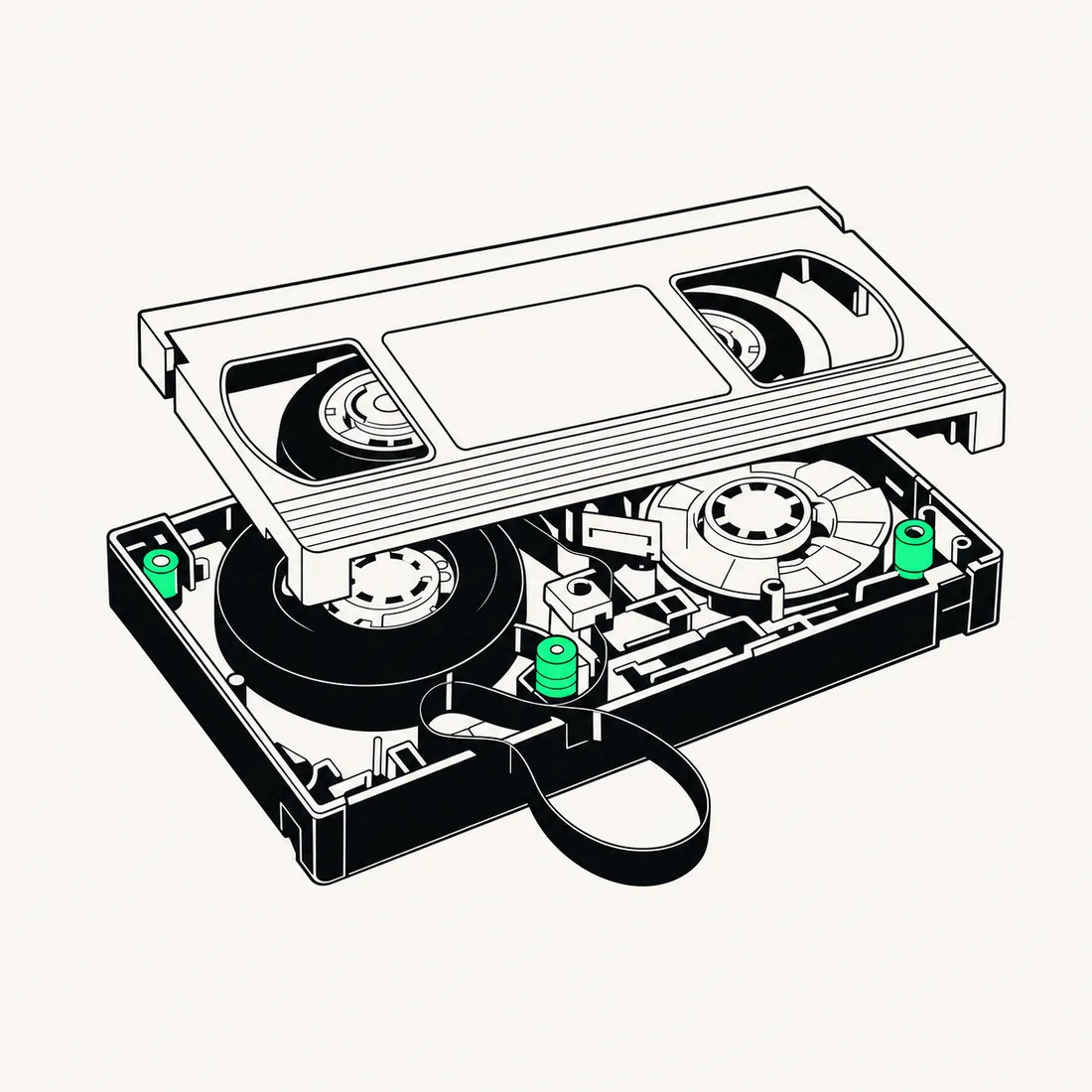
Standard VHS is the big black cassette, roughly the size of a paperback book. It dominated home video from the early 1980s through the early 2000s, which means most family archives have at least a few. The catch: consumer-grade VCRs stopped being manufactured years ago, and the ones still in attics and closets are aging out fast. A tape that plays back fine today may not next year — not because the tape degraded, but because there's nowhere left to play it.
VHS-C — the "compact" cousin that fools people
VHS-C looks like a shrunken VHS tape, small enough to fit inside a camcorder. It uses the exact same tape formulation as full-size VHS, just wound onto a smaller reel — which is why it needs a special adapter (or a camcorder) to play, not a standard VCR. If you find one of these in a box labeled "VHS," don't assume a VHS deck can read it directly.
Hi8 and Digital8 — the camcorder tapes from the 90s
Hi8 tapes are small silver cassettes, most commonly found loaded into camcorders from the 1990s. Digital8 looks nearly identical but records a digital signal instead of analog — the two are easy to mix up by sight alone. Both formats deliver noticeably sharper video than VHS ever did, which makes them worth prioritizing: there's more picture quality to lose if the tape degrades before it's transferred.
MiniDV — the format that looks like it should still work fine
MiniDV tapes are tiny — barely bigger than a matchbook — and record a genuinely digital signal, which leads to a common misconception: people assume "digital" means "doesn't degrade." It still does. The tape itself is physically identical to any other magnetic tape, and the miniature camcorders built to play it are now old enough to be failing at roughly the same rate as the media itself.
Betamax — the format that lost, but didn't disappear
If you find a tape shaped like a fat VHS cassette but slightly smaller, it might be Betamax — Sony's competitor format that lost the format war to VHS in the 1980s but still shows up in older family archives. Working Betamax decks are considerably rarer than VCRs at this point, which makes these a higher priority to digitize sooner rather than later.
Quick reference: what you're probably holding
| Format | Looks Like | Common Era |
|---|---|---|
| VHS | Large black cassette | 1980s – early 2000s |
| VHS-C | Small cassette, needs adapter | Late 1980s – 1990s |
| Hi8 | Small silver cassette | 1990s camcorders |
| Digital8 | Looks like Hi8, digital signal | Late 1990s – early 2000s |
| MiniDV | Tiny cassette, matchbook-sized | Late 1990s – 2000s |
| Betamax | Squarer, slightly smaller than VHS | Late 1970s – 1980s |
Why the format matters more than most people think
Every format above requires different playback hardware, and that hardware is disappearing at different rates. VCRs are relatively easy to find secondhand; working Betamax decks are not. This is why we don't quote "video tape digitizing" as a single flat rate assuming every tape is the same — the deck, the calibration, and the handling all vary by format, even though the end result is the same digital file either way.
If you're not sure what you're holding, that's the normal starting point for most people who bring in a box. Send us a photo of the label and shell shape, and we can usually identify the format before anything even leaves your hands.