
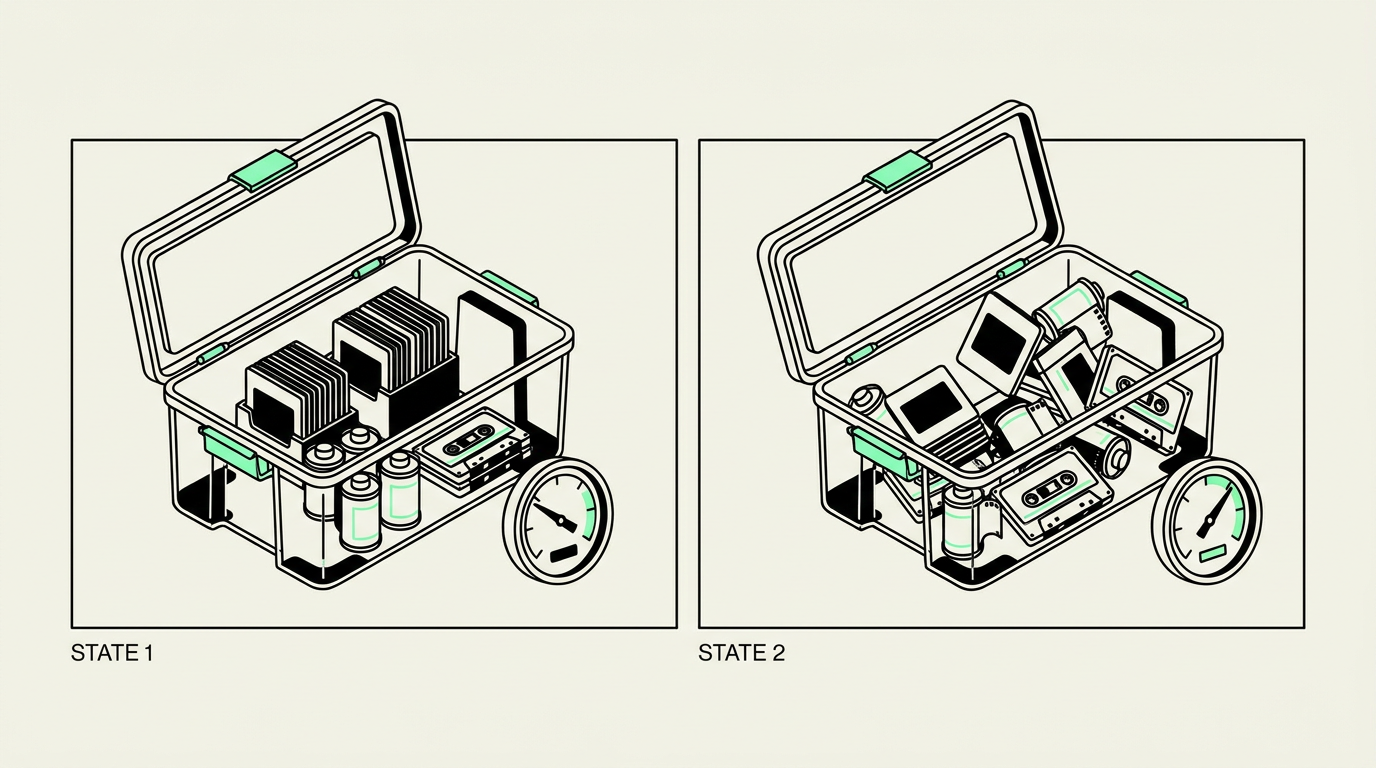
Move old photos, film, and tapes from a hot garage into a stable, air-conditioned room, keeping them away from direct sunlight and cooling vents. Let the contents reach room temperature before opening cases or handling individual items, and do not test-play tapes or project film that looks damaged. Heat exposure does not automatically mean your memories are lost, but careful handling now can prevent additional damage.
Start with the box, not the playback machine
Finding a family archive in a Chandler garage can create an understandable urge to see what survived. Resist plugging in the old projector or VCR right away. The equipment may have deteriorated alongside the recordings, and a machine with failing belts or a dirty tape path can damage otherwise recoverable material.
Carry boxes from underneath rather than trusting brittle handles. Keep film reels and loose photo collections supported so they cannot spill. If a container is dusty, wipe its exterior before opening it indoors, without letting moisture reach the contents.
Do not put hot media in a refrigerator or freezer to cool it quickly. Household cooling shortcuts can introduce moisture and abrupt temperature changes. There is no universal waiting time for a packed box: allow the contents, not just the outside of the container, to reach room temperature naturally.
Look for warning signs without forcing anything
Work on a clean, dry table and inspect a few items at a time. You are checking whether normal handling is safe, not trying to repair the collection. Stop when opening, separating, or moving something requires force.
- Stuck surfaces: Prints clinging together, negatives stuck in sleeves, or album pages bonded to photographs need assessment before separation.
- Distorted shapes: Warped cassette shells, buckled film, or bent discs may not travel safely through playback equipment.
- Loose material: Flakes, powder, or debris inside a tape case can indicate deterioration. Avoid shaking the case or opening the shell.
- Unusual odors or growth: A vinegar odor from film or fuzzy growth on media deserves separate handling. Do not sniff closely or brush suspected mold indoors.
If you see suspected mold, keep the affected container apart from clean items and call before bringing or mailing it anywhere. A visual inspection cannot reveal every problem, but it can help prevent an avoidable playback failure.
Handle each format differently
Photo prints, slides, and negatives
Hold prints by their edges and avoid touching the image surface. Handle 35mm slides by their mounts and negatives by their edges. Heat can worsen curling and contribute to sticky or deteriorating enclosures, so do not pull a negative strip from a sleeve if it resists.
Leave stuck prints and photographs attached to album pages as you found them. Water, household cleaners, heat from a hair dryer, and improvised flattening can cause permanent damage. A slide carousel can stay loaded if the slides are secure; there is no need to remove every mount just to count them for an initial inquiry.
8mm and Super 8 film
Keep film on its existing reel rather than unwinding it across a table. Brittle film and weakened splices can break under tension, while shrinkage can make projector transport unsafe. A strong vinegar smell can signal acetate film deterioration; keep affected reels separate from unaffected material and ask for handling guidance rather than sealing them into a shared airtight bin.
Do not run film through a projector simply to identify its contents. Note any writing on the reel or can and let the transfer provider know about odors, distortion, or loose film ends before an assessment.
VHS, Hi8, Digital8, and audio cassettes
Leave cassette shells closed and do not pull exposed tape or turn reels to tighten a questionable tape pack. A shell that looks normal does not prove the tape inside is ready for playback. Likewise, a faded label does not prove that the recording is damaged.
Avoid repeated fast-forwarding and rewinding as a test. If a tape has already squealed, stopped, or shed debris during playback, stop using it and report that history. Do not try home baking or add lubricants.
DVDs and audio CDs
Handle discs by the outer edge and center hole. Set aside any disc with cracks, warping, or visible layer separation; a cracked disc should not be spun in a drive. Avoid abrasive polishing, particularly before you know whether the problem is surface dirt or damage within the disc.
Plan the next step without another heat exposure
Make a rough inventory by format and note which containers show warning signs. Exact footage, running times, and individual photo counts can wait if counting would require risky handling. Phoenix Scanning’s digitizing services cover photos, 35mm slides, negatives, 8mm and Super 8 film, videotapes, DVDs, audio cassettes, and audio CDs.
For an East Valley handoff, avoid leaving the collection in a parked car while running errands. Phoenix Scanning offers drop-off and local pickup in Chandler, AZ 85224. Call (480) 272-2447, Monday–Friday, 9am–5pm, to discuss questionable material, or start a quote for the collection.
Mail-in customers anywhere in the US can request a free prepaid shipping label. Mention suspected mold, strong odors, or fragile items before packing so handling questions can be addressed first.
Common questions
Does garage heat mean my photos and tapes are ruined?
No. Condition depends on the material, temperature, exposure time, and other storage conditions. Inspection and, when safe, scanning or playback are needed to learn what can be recovered.
Should I play a tape once to see whether it survived?
Not if the tape or shell shows damage, debris, or suspected mold. Avoid using an old, untested player as a condition check.
Can I peel apart photos that stuck together in storage?
Do not force them apart or soak them at home. Keep them together and ask about assessment before attempting separation.
Should I bring the whole box or only the damaged items?
Call first if anything has suspected mold or a strong unusual odor. Keep affected items separate, and describe both the formats and the condition before arranging a handoff.